
From Saturn to Jupiter
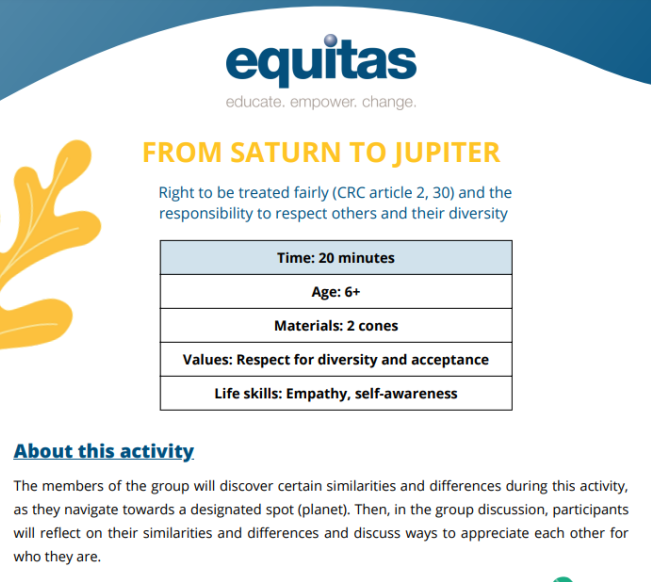
Activity to help foster respect for children’s rights and diversity by inciting children and youth to reflect on their peers’ similarities and differences. Also available in French.
To be a better ally
Tip sheet on how to be a better ally towards BIPOC folk and when engaging in the fight for racial justice. The document offers advice on how to educate yourself, how to become aware of your own privileges and unconscious biaises, and how to use your voice and activism to dismantle racist and oppressive spaces. […]
Guide rapide d’écriture inclusive d’Equitas
Quick guide on Equitas’ French inclusive writing practices since 2023, which revolves on two main techniques, i.e. epicene writing and truncated form, but also syntactic feminization and non-binary writing in certain cases. Only available in French.
Strategies to enhance participation of women and marginalized people
This good practice explores the creation of inclusive conditions for greater participation of women and traditionally marginalized people in human rights education activities. It proposes tangible measures to reduce barriers before, during and after a human rights education activity. Available in French.
Integrating a trauma-informed approach into human rights education work
A trauma-informed approach allows human rights educators to carry out their activities, particularly activities related to sensitive topics, in a manner that mitigates the risk of reproducing harm. The following examples of how to integrate a trauma-informed approach are drawn from human rights education activities in Tanzania that aim to address gender-based violence, particularly sexual […]
Gender-sensitive budgeting in human rights education activities
This good practice offers guiding questions and reflections on how to include a gender perspective while budgeting for human rights education activities that took place in Kenya. It defines the term “gender-sensitive budgeting”, and highlights the importance of adopting a gender-sensitive budget to advance gender equality. Also available in French
What is intersectionality?
This video was created as part of the Global Rights Connection 2022 human rights online training. It does a quick review of how the concept of intersectionality was developed and how it is used today as a framework to situate oppressions, as well as how it fosters inclusivity. Also available in French.
National Child Day 2022 – Race to inclusion
This booklet was created to celebrate National Child Day and to support children in learning more about their rights and the United Nations Convention on the Rights of the Child. This year we are focusing on the right to be and to feel included regardless of identity. Also available in French.
Inclusion definition
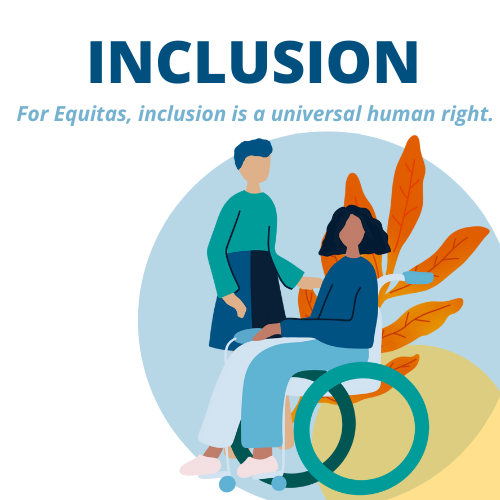
A working definition of the word “Inclusion”. This definition guides the work of the Inclusion Learning Committee at Equitas. A reference/resource for those who wish to work on the concepts of inclusion, belonging, and accessibility. Also available in French
Bridging our Diversities: Building Equitable and Inclusive Communities
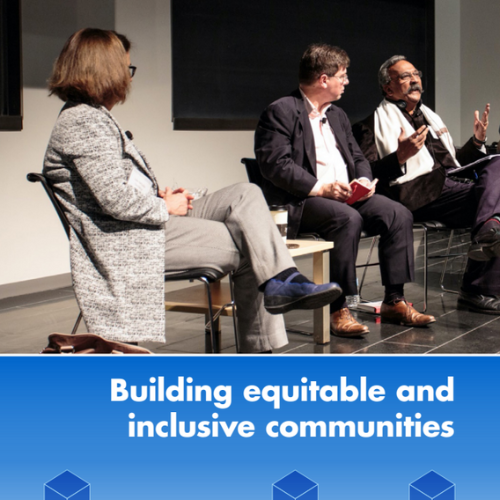
This chapter of Bridging our Diversities: A Compendium of Good Practices in Human Rights Education provides effective human rights education strategies for enabling the meaningful participation of all people in their communities, regardless of their status or position, ethnicity, age, income, sexual orientation, gender identity, language or ability. Also available in French